
An X article published by NO1ennn on 27 August proposes a striking operating model: six specialised AI agents, each responsible for one business ledger, coordinated by a seventh routing role, with consequential money actions stopping at a human approval queue. The useful idea is not the claim that one person can effortlessly run six companies. It is the separation of ownership, evidence, routing and authority.
This field guide checks the product and model claims against first-party material, preserves the source article's full media set, and translates the concept into controls a real team could test. The revenue figures in the source are scenario arithmetic, not receipts or verified business results. Treat them as assumptions to challenge.
Read the original X article by NO1ennn.
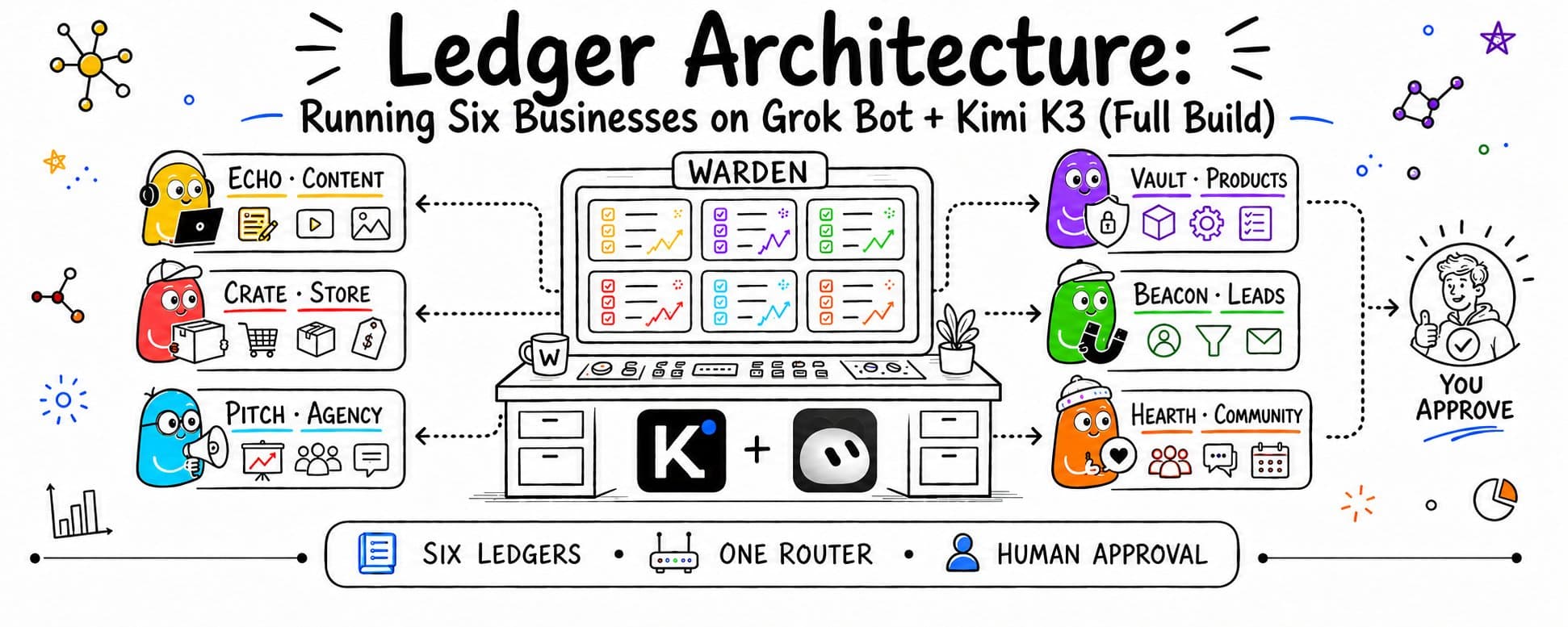
The architecture in one sentence
Give each agent one bounded ledger, make a separate router decide what deserves attention, require evidence on every material claim, and keep the final authority for money, deletion, pricing and external commitments outside the model.
The source pairs two products because they occupy different layers:
| Layer | Proposed role | Verified position |
|---|---|---|
| Grok Bot | Ready-made persistent computer and multi-bot workspace | xAI says Bots have their own computer, can sign into tools, run on schedules, work in parallel and keep running while the user's laptop is closed |
| Kimi K3 | Reasoning model that can power a more portable or self-hosted build | Moonshot describes K3 as a 2.8-trillion-parameter, 104-billion-active MoE model with 896 experts, native vision and a 1,048,576-token context window |
| Kimi Code | Agent shell with file, terminal and web tools | Moonshot presents Kimi Code as its coding-agent framework and documents file editing, shell execution, web research and subagents |
| The ledger desk | Application architecture above the products | This is the author's design pattern, not a packaged capability guaranteed by either vendor |
The official Kimi K3 repository confirms the architecture and context figures. The official Grok Bot page confirms the persistent-computer, scheduling, multi-bot and tool-login experience. Neither source validates a six-business revenue outcome.
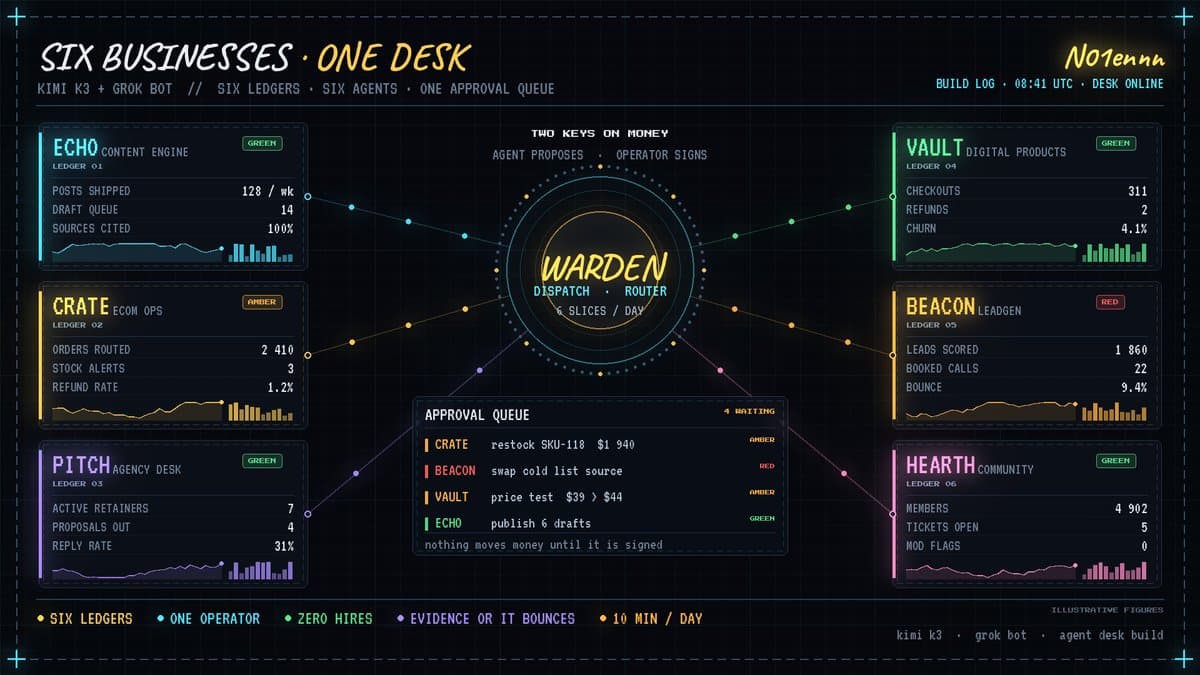
Six ledgers, not six personalities
The strongest decision in the source is to organise agents around accountable state rather than around a collection of tools. Each seat owns a business result and has an explicit refusal boundary.
| Seat | Ledger | Owns | Must not do |
|---|---|---|---|
| ECHO | Content studio | Published work, reach and list growth | Pitch or invoice |
| CRATE | Ecommerce | Orders shipped and contribution margin by SKU | Change prices or cancel supply commitments |
| PITCH | Service agency | Qualified calls and signed retainers | Deliver client work |
| VAULT | Digital products | Units sold and refund rate | Run paid acquisition |
| BEACON | Lead generation | Qualified leads delivered | Negotiate commercial terms |
| HEARTH | Community | Active members and churn | Issue credits or refunds |
| WARDEN | Shared desk | Priority, routing, cash view and approval cards | Perform the operators' work |
The labels are memorable, but the refusal column does the real engineering. If the router also writes copy, edits a store and negotiates with prospects, it is no longer an independent control point. If every agent can see every ledger, a prompt injection or credential leak can cross the entire organisation.
The implementation should therefore give each operator a distinct data slice, tool allow-list, credential scope and write policy. Our guide to delegated agent credentials explains why short-lived, audience-bound authority is safer than placing shared reusable keys inside the agent environment.
Three ways to run Kimi K3
The source describes three paths, but their operating burdens differ sharply.
1. Start with the hosted API
Moonshot's Kimi K3 quickstart exposes the model as kimi-k3 through an OpenAI-compatible endpoint. The API requires a funded account and supports low, high and max reasoning effort. This is the fastest route for evaluation because there is no cluster to operate.
The trade-off is supplier dependence. Record the exact model identifier, region, price, rate limits, reasoning setting, prompt package and observed behaviour. A million-token ceiling is not a reason to send every ledger to every request; smaller authorised slices are easier to secure, test and audit.
2. Use Kimi Code as the agent shell
The official Kimi Code page provides a terminal installer and describes a CLI that reads and writes files, runs commands, fetches web material and can use subagents. Review any remote installer before piping it into a shell, then begin in a disposable workspace with read-only or mock integrations.
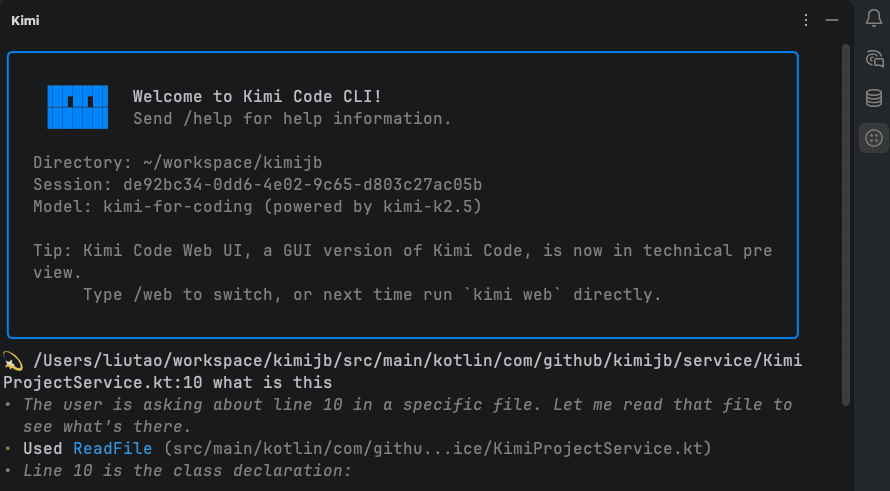
Kimi Code is an execution surface, not an authorisation system. File access, terminal access and MCP tools create real capability. Put policy checks at the tool boundary, restrict the working directory, keep production secrets out of prompts and make every side effect idempotent.
3. Self-host only when the workload justifies it
K3 is open-weight, but it is not an ordinary laptop model. The official vLLM recipe calls for at least eight GB300-class GPUs, with multi-node infrastructure for production traffic; it also provides an AMD MI350X/MI355X path. The Hugging Face model card lists vLLM and SGLang serving options, while Moonshot's repository also names TokenSpeed.
Self-hosting becomes rational when privacy, control, throughput or sustained token volume outweigh the cluster, inference, observability and upgrade burden. Benchmark the actual ledger tasks and compare cost per accepted outcome—not only tokens per second. Validate tool-call parsing too: the current vLLM recipe warns that K3 can occasionally emit a tool-call shape its parser does not expect and recommends schema validation and retry.
Grok Bot is the fast product experience
xAI positions Grok Bot as an AI teammate with its own computer. The product page says Bots can sign into tools, preserve context, learn routines, work together in shared threads and run continuously. It also says access is included with eligible Grok, Cursor and team plans, with plan-specific usage limits.
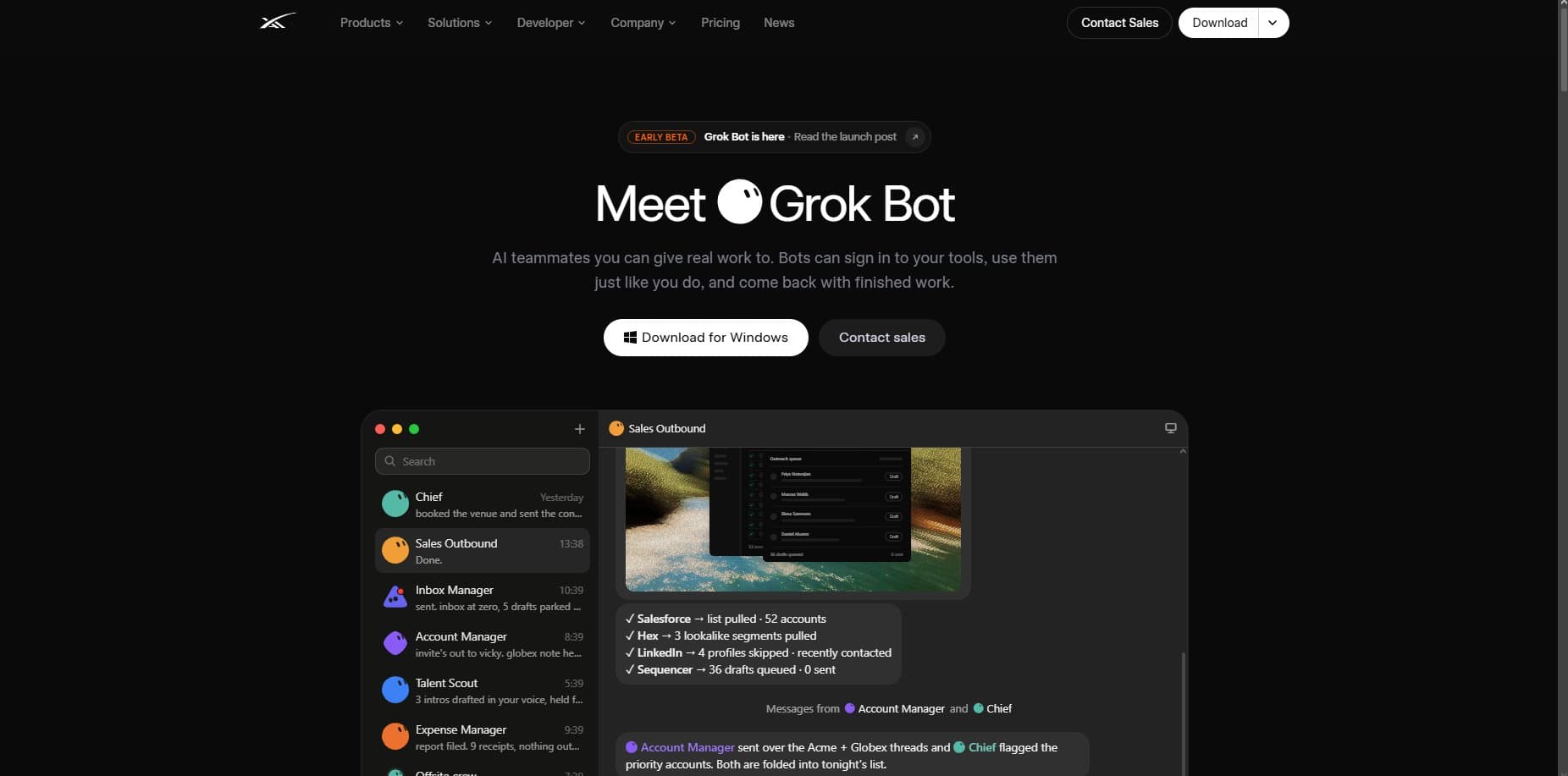
That convenience creates a security question the source correctly surfaces: what shares the computer, session or credential boundary? A convenient shared environment is helpful for handoffs, but it can enlarge the blast radius. Confirm the vendor's current isolation and data-handling terms, scope each connected account to the smallest useful role, and do not assume that separate bot names mean separate security principals.
The four controls worth keeping
Two keys for money
No single agent should be able to propose, verify and commit a financial action. The operator can prepare a restock proposal; WARDEN can verify cash, stock cover and open purchase orders; a human can approve the exact operation. The destination still needs to check amount, supplier, tenant, current state and operation identity.
Human approval does not prevent duplicate execution. A timeout or queue redelivery can replay the same approved action. Use one durable idempotency key for the approved business intent and require the system of record to reject duplicates or stale versions, as described in our agent concurrency field guide.
A code-enforced action ladder
The source uses green, amber and red actions. The pattern is useful, but we would tighten its commit semantics:
| Class | Safe default | Examples |
|---|---|---|
| Green | Run automatically inside a bounded, reversible workspace | Read an authorised report, draft copy, score a lead, write to a scratch file |
| Amber | Prepare the change and require a policy check or review before external commit | Schedule a post, change a CRM stage, send a support reply |
| Red | Block until a named human approves the exact current action | Transfer money, alter price, launch paid ads, email a list, refund, delete or cancel |
The policy must live outside the prompt. A model instruction is evidence of intended behaviour; a tool gateway is what can deny the call. Run every proposed action through structural validation, semantic checks, evidence checks, authorisation and a safe commit boundary. The five action-validation gates show how those layers fit together.
Provenance on every material number
A handoff that says “sell-through is healthy” is not sufficient. Carry the value, unit, source URI, source version or query, read time, producer and ledger. Reject missing provenance as invalid input instead of asking the next model to guess.
| Handoff field | Purpose |
|---|---|
| from / to | Names the accountable producer and consumer |
| ledger / kind | Defines the state boundary and work type |
| value / unit | Prevents a prose claim from hiding the actual measure |
| evidence | Points to the authorised source records used |
| observed_at | Establishes freshness |
| expires_at | Stops stale leads, prices or approvals returning later |
| operation_id | Gives retries one stable identity |
Expiring approvals and least context
An approval card should expire when its business context is stale. WARDEN should not “repair” missing evidence by searching broader data; it should bounce the proposal to its owner with the missing field named. Each agent should receive only its own ledger slice plus the minimum cross-ledger facts required for the handoff.
That is the architectural version of least privilege: an agent cannot be persuaded to misuse data it never received and tools it cannot invoke.
Handoffs turn separate agents into a company
The source's commercial loop runs from content to leads, sales, onboarding, repeated customer questions, digital products and back to launch content. Ecommerce sits beside the loop and contributes cash information rather than customer data.
This can work only if handoffs are explicit events, not messages dropped into a common chat. A qualified-lead event, for example, should contain a bounded company identifier, the trigger, a fit score, supporting source references, consent or contact-policy state, and an expiry. The receiving agent should acknowledge or reject it; WARDEN should observe status without inheriting permission to use the entire originating ledger.
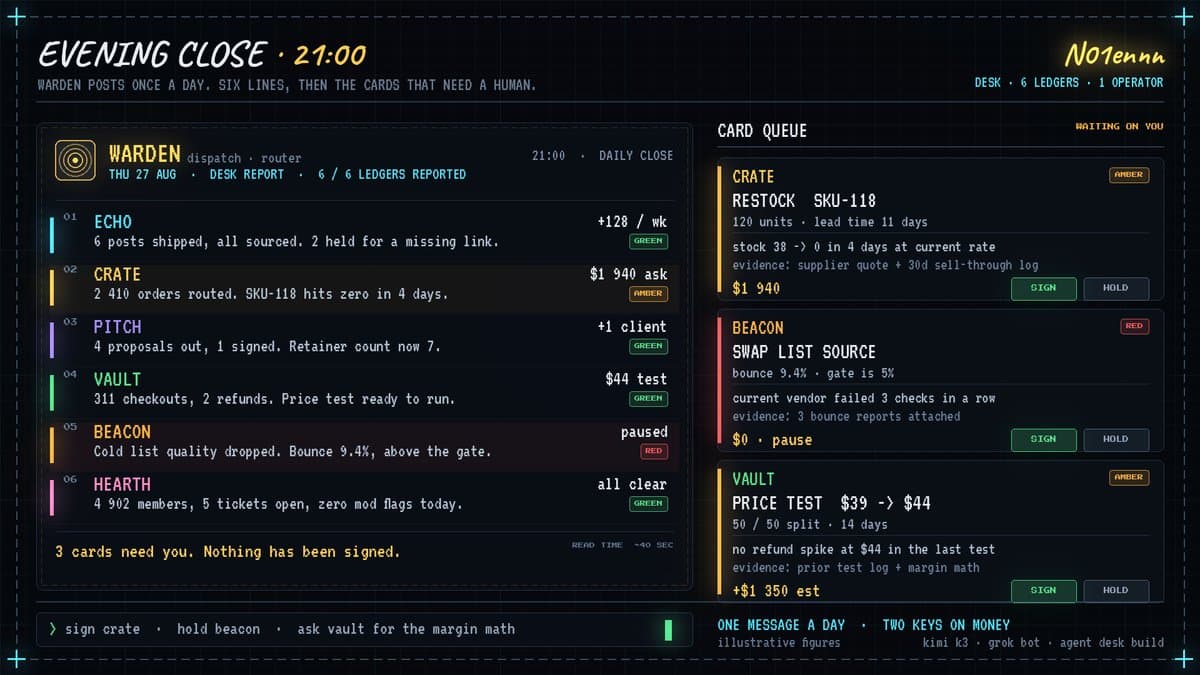
A predictable daily rhythm is more valuable than continuous chatter:
- Morning state pull: each operator writes a short, source-backed ledger snapshot.
- Priority route: WARDEN builds one ranked list without doing operator work.
- Bounded execution: each seat works only its top items; amber and red actions become cards.
- Evening close: every ledger reports one result, exceptions and unresolved evidence.
- Human queue: the operator approves, holds or rejects current cards; expired cards die.
The claimed “ten minutes a day” is an aspiration, not an operating guarantee. Measure review time, exception volume, correction rate and the number of actions that return because their evidence was incomplete.
The economics are a model, not proof
The source explicitly says its figures are modelled. Its example reaches $102,870 per month by combining six assumed revenue streams:
| Ledger | Source scenario |
|---|---|
| Service agency | Eight retainers at $4,500 = $36,000 |
| Digital products | 620 units at $39 = $24,180 |
| Ecommerce | 1,400 orders at $14 contribution margin = $19,600 |
| Lead generation | Three clients at $3,500 = $10,500 |
| Community | 410 members at $19 = $7,790 |
| Content studio | Sponsorship and affiliate income = $4,800 |
The same scenario estimates $1,300–$2,300 per month for model usage, tools, hosting, data and subscriptions. Those inputs omit acquisition difficulty, fulfilment, returns, taxes, payment fees, compliance, creative work, customer trust, bad debt and the human time required to build and supervise the system. They also assume all six offers already have demand.
The metric to keep is cost per accepted finished task, paired with revenue or operational value actually attributable to that task. Track model and tool cost, retries, reviewer minutes, correction, recovery and failed handoffs. A cheap run that creates an expensive exception is not efficient.
An eight-week build order with a harder gate
The source recommends growing from one ledger to six. That sequence is sound if each stage has an evidence gate:
| Period | Build | Exit evidence |
|---|---|---|
| Week 1 | Run one existing revenue ledger manually through the agent | Every stall, guess and missing source becomes a charter rule |
| Week 2 | Classify actions and enforce the tool boundary | Red-team attempts cannot make the agent spend, delete or publish outside policy |
| Week 3 | Add a second ledger and the router | Ownership, provenance and rejection paths work across the first handoff |
| Week 4 | Automate one directional cross-ledger event | The event is acknowledged, expires correctly and cannot leak the full source ledger |
| Weeks 5–6 | Add two more ledgers | Existing controls are reused without broadening credentials |
| Week 7 | Add scheduling, SDK orchestration and review queue | Overnight runs reconcile every attempted and completed action |
| Week 8 | Add the final two ledgers only if the first four are stable | A full week passes within agreed error, review-time and cost thresholds |
Do not use “the first four ran without opening a terminal” as the only success condition. An unattended run can be quietly wrong. Require sampled accuracy, provenance completeness, permission tests, side-effect reconciliation and recovery drills.
Failure modes the glossy diagram hides
- Shared credentials create shared blast radius. Separate bot names do not narrow a master account.
- One base model creates correlated blind spots. Use deterministic validation and consider a genuinely independent verification path for high-impact work.
- A poisoned source can create confident agreement. Diversity of agents does not help when they all read the same compromised feed.
- Coordination cost grows quickly. More agents mean more queues, schemas, timeouts, ownership disputes and partial failures.
- Tool-shaped agents dilute accountability. An “email agent” and a “spreadsheet agent” can move work, but neither owns the business result.
- A dispatcher that performs work cannot remain neutral. WARDEN should route and verify, not quietly become the most powerful operator.
- A long context window is not a permission model. Context capacity says what the model can receive, not what it should receive.
AIEngine verdict
The six-agent story is compelling because the org chart makes boundaries visible. The reusable pattern is smaller and more practical: one ledger per accountable outcome, one explicit owner, one refusal list, one evidence [contract](/industries/legal), one routing layer and a human-controlled commit boundary.
Grok Bot can provide the fastest way to prototype the experience. Kimi K3 and Kimi Code can provide a more configurable reasoning and execution stack, while self-hosted K3 is a cluster-scale decision rather than a casual local install. None of those products supplies the business demand, control evidence or financial proof by itself.
Start with the ledger already producing value. Prove that the agent can read it accurately, reject missing evidence, remain inside its permissions and survive retries without duplicate side effects. Add a second seat only when the first is boring, measurable and recoverable. That is how the appealing diagram becomes an operating system rather than another group chat with tools.
Media and source note
The diagrams, product screenshots and installation clip embedded above were published with the original X article by NO1ennn and are reproduced here for attributed reporting and commentary. Product interfaces and marks remain those of their respective owners. The hero is an original AIEngine editorial illustration generated for this coverage.