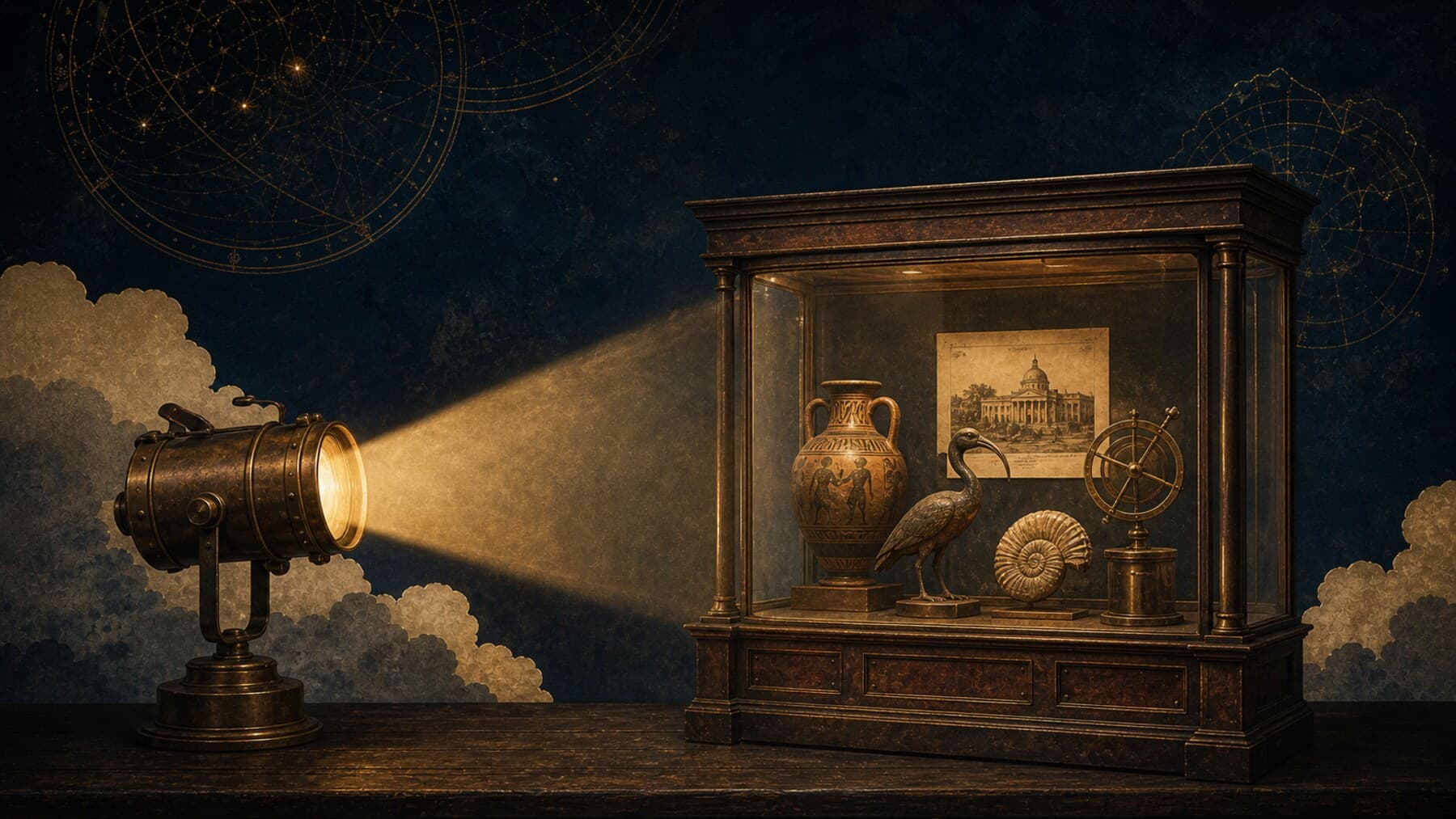
AI can suggest an optional route, search inconsistent catalogues, compare image features and help prototype a reconstruction. It cannot decide what is meaningful for every visitor, authenticate an artwork more accurately than “human experts” as a general rule, or fill historical gaps without interpretation. Museums hold evidence, relationships and public trust; an AI system must remain subordinate to all three.
This guide is current to 31 July 2026. UK museums differ by nation, governance, funding, collection, public-sector status and legal duties. Copyright, cultural property, human remains, equality, data protection and sector accreditation require case-specific review. Treat this as an operating framework, not a legal or attribution opinion.
Begin with mission, community and collection authority
Define the museum purpose the system should advance: make an existing trail easier to navigate, improve catalogue retrieval, draft transcription, compare conservation images, or show alternative evidence-based reconstructions. “Personalise engagement” is too broad to evaluate and invites unnecessary surveillance.
The Museums Association’s 2025 Code of Ethics centres equitable, inclusive, transparent, accountable, responsible and sustainable practice. Its transparent and accountable principle specifically calls for responsible, transparent AI use, organisational risk-benefit assessment, accountable data stewardship and digital access that protects rights, dignity and agency.
Create a use-case record with:
- intended visitors or collection workers;
- source records and their known gaps;
- communities, artists, lenders and rights holders affected;
- decisions the tool may inform but not make;
- public labels and correction route;
- accessibility and non-digital alternative;
- named curator, collection, digital, rights and security owners;
- evaluation and stop conditions.
Involve people represented in and served by the collection before selecting data and output. A technically coherent model may repeat a colonial catalogue voice, suppress contested names or treat culturally restricted material as generic training data. Consultation is not a final usability session; it helps decide whether the use should exist.
| Proposed use | Evidence before release |
|---|---|
| Visitor route | Declared preferences, access test and non-digital alternative |
| Catalogue draft | Original record, reviewer and correction history |
| Reconstruction | Source map, uncertainty legend and rights clearance |
Recommend routes without profiling the visitor
A route engine can filter by time, lift access, seating, sensory environment, language and declared themes. It should ask visitors what they want rather than infer disability, age, emotion, ethnicity or faith from cameras, devices or companions.
Provide a guest mode and useful default routes. Let a visitor choose pace, distance, stairs, quiet spaces, captions, audio and content warnings. Keep access preferences on device or for the shortest necessary period where possible. Do not require an account to receive an accessible visit.
“Meaningful” is not a model label. Offer several routes and explain why an item appears: “nearby and linked to your chosen theme”, not “selected for someone like you”. Let people change or abandon the route. Preserve serendipity, staff recommendations and complete-gallery access so ranking does not create a hidden canon.
Measure completed visits, navigation errors, requested adjustments, dwell only with care, optional satisfaction and whether people reached their stated aim. Do not optimise maximum dwell time, spending or emotional intensity at the cost of fatigue and choice.
Public-sector museum websites and apps may fall within accessibility regulations. GOV.UK’s accessibility requirements reference WCAG 2.2 AA and an accessibility statement. Test with disabled users and common assistive technologies; a generated audio description or route must still be accurate, navigable and adjustable.
Authentication remains a multidisciplinary attribution process
Image models can compare brushwork, craquelure or composition; other systems can analyse spectra, material records and provenance networks. Each input has different uncertainty and can be manipulated. A model trained on photographs may learn camera, restoration, framing or collection-specific patterns rather than authorship.
Use AI to rank questions and comparable works, never to issue a certificate. A defensible attribution combines provenance, connoisseurship, technical imaging, material science, condition, archival research, chain of custody and expert debate. A strong match on one feature cannot repair a missing ownership history or an anachronistic pigment.
Build an evaluation set with known works, known non-works, workshop pieces, copies, restorations and disputed attributions. Separate works or artists across train and test to prevent memorisation. Report false positives and false negatives at decision-relevant thresholds, confidence calibration, missing data and performance by medium and imaging setup.
Retain the original record and all dissent. Label the model, training boundary, feature source and date. Never feed an AI conclusion back into the catalogue as independent provenance. Require a formal curatorial and scientific review before changing attribution, value, loan, display or publication.
For suspicious provenance, consult legal and specialist cultural-property expertise. A model-generated chain of ownership or archive reference is not evidence. Link users to the original source and mark unresolved periods explicitly.
Build from sound collection information
Collections Trust’s Spectrum 5.1 is the UK collections-management standard and includes 21 procedures, from inventory and cataloguing to use, rights management, audit and emergency planning. An AI project should fit those controls instead of creating a parallel synthetic catalogue.
Before modelling, reconcile identifiers, object status, location, rights, lender restrictions, sensitivity, preferred terminology and record provenance. Preserve every source value and make generated text a separate, reviewable layer. Record who approved a change and why.
For transcription or entity extraction, show the scan beside the draft. Measure critical fields separately: accession number, creator, date, location, rights and cultural restrictions carry more consequence than punctuation. Do not “complete” an absent field. Use unknown, not yet researched, withheld and contested distinctly.
The UK library and archive AI guide covers provenance-preserving digitisation in more detail. Museum records need the same ability to trace each assertion to the physical object or authoritative source.
For excavation records, site interpretation and uncertain finds, the UK archaeology and heritage AI guide adds field-specific controls. Do not allow a generated museum narrative to become evidence in the archaeological record that it merely summarised.
Make reconstruction visibly interpretive
A historical visualisation should separate:
- observed: surviving fabric, excavation, object or contemporary record;
- inferred: supported by comparable evidence and expert reasoning;
- speculative: one plausible choice among alternatives;
- invented for experience: narrative connective material with no evidential claim.
Use a visual legend, not only small-print terms. Let visitors switch layers or compare alternatives. Cite the excavation report, plan, image, text or analogue behind material choices. State location and date, because a Roman town or medieval castle changed across phases.
Generative polish increases false confidence. Avoid photorealism where evidence is sparse, or interrupt it with visible uncertainty. Do not generate identifiable historical people as if their face, voice or behaviour were known. Treat sacred sites, burial, trauma and living cultural heritage with community-led rules and content warnings.
DCMS guidance on human remains in museums recognises their unique personal, cultural, spiritual and religious significance and recommends respectful, contextual display. A generated avatar or AR overlay does not avoid those responsibilities.
Offer captions, transcripts, audio description, reduced-motion and non-headset alternatives. Test cybersickness, tracking loss, occlusion, emergency egress and use by glasses or hearing-aid wearers. An immersive feature must never obstruct the physical safety or dignity of visitors.
Clear rights before digitisation and generation
Possession of an object does not necessarily include copyright in the work, image, text, performance or recording. Check artist, lender, photographer, donor, performer, publisher and database rights. Record permitted territory, duration, media, modification, commercial use and model training separately.
The Intellectual Property Office’s orphan works guidance explains that UK cultural institutions cannot freely publish a work merely because the right holder cannot be found. Consider diligent search, licensing and applicable exceptions with advice.
Do not upload restricted collection images to a public generator under terms that permit training or retention. Contract for input and output use, subprocessors, location, deletion, confidentiality, infringement handling, change notice and exit. Label generated material and preserve prompt, approved assets, model/version and human edits.
Respect cultural authority beyond copyright. Some material should not be publicly indexed, remixed or viewed by all audiences even when a narrow legal route might exist. Build technical access controls from the collection decision.
Protect visitors, collections and staff
Route data can reveal visits, interests, disability-related choices and companions. Minimise it, establish a lawful basis, provide clear privacy information, avoid cross-visit identity by default and complete a DPIA where required. Never use sensitive exhibition interest to create a marketing audience without a separate lawful, expected process.
Secure collection systems, exhibit devices and AI services with least privilege, segmentation, patching, allowlisted data flows and tested backups. A public kiosk is hostile territory. Prevent visitors from escaping the app, extracting catalogue credentials or injecting instructions into connected agents.
Follow the NCSC’s secure AI system development guidelines. Threat-model poisoned public submissions, malicious QR codes, compromised suppliers, model hallucination, cross-collection leakage, vandalised sensors and network outage. Exhibits need a graceful offline mode and staff override.
A measurable 90-day pilot
Days 1–30: choose and prepare
Select one low-risk use, such as an optional route using declared preferences or draft transcription of a non-sensitive collection. Confirm mission fit, communities, rights, collection procedure, privacy and access. Create a gold sample and baseline for findability, staff time, critical errors and visitor task completion.
Gate 1: no public output or vendor upload until curatorial, community where relevant, rights, privacy, accessibility and security owners approve the sources and boundary; no restricted material in training.
Days 31–60: shadow and challenge
Run staff-only. Test incomplete and contradictory records, contested names, multiple languages, low-quality images, forgeries, prompt injection, offensive generation, inaccessible routes and outage. Sample apparent successes and low-confidence cases. Keep originals visible and log corrections by severity.
Gate 2: no attribution change, public reconstruction or personalised route unless every claim traces to evidence or is visibly marked uncertain, accessibility tasks pass and humans can override. No high-consequence decision from a model score.
Days 61–90: limited public release
Offer an explicit choice to a small cohort with a normal route or catalogue alongside. Review corrections, complaints, exclusion, route failures, visitor understanding, rights incidents, staff workload and security signals weekly. Observe whether people can distinguish evidence from invention.
Gate 3: expand only if the intended access or collection outcome improves without material trust, rights, inclusion or conservation harm. Pause after fabricated provenance, hidden sensitive material, discriminatory route, inaccessible critical function, cross-visitor disclosure, misleading reconstruction or unauthorised reuse.
The practical verdict
AI can help people search, compare and explore a collection. It cannot inherit the museum’s authority or settle evidence that remains disputed.
Keep original records, community relationships and professional judgement visible. Give visitors choices and show uncertainty in the experience itself. A successful intelligent exhibit is not the most seamless illusion; it is the one that deepens curiosity while making clear what survives, what experts infer and what the machine only imagined.